



Intro to Earning
Overview
A paycheck is a powerful thing. You use it to pay for what you need today, and to save for what you’ll need tomorrow—a down payment for a home, a college education, a comfortable retirement. In other words, your paycheck is the foundation for your entire financial life. Yet many people are mystified by it. Getting your financial house in order starts with understanding exactly what’s going on with your paycheck.
How do taxes affect my paycheck?
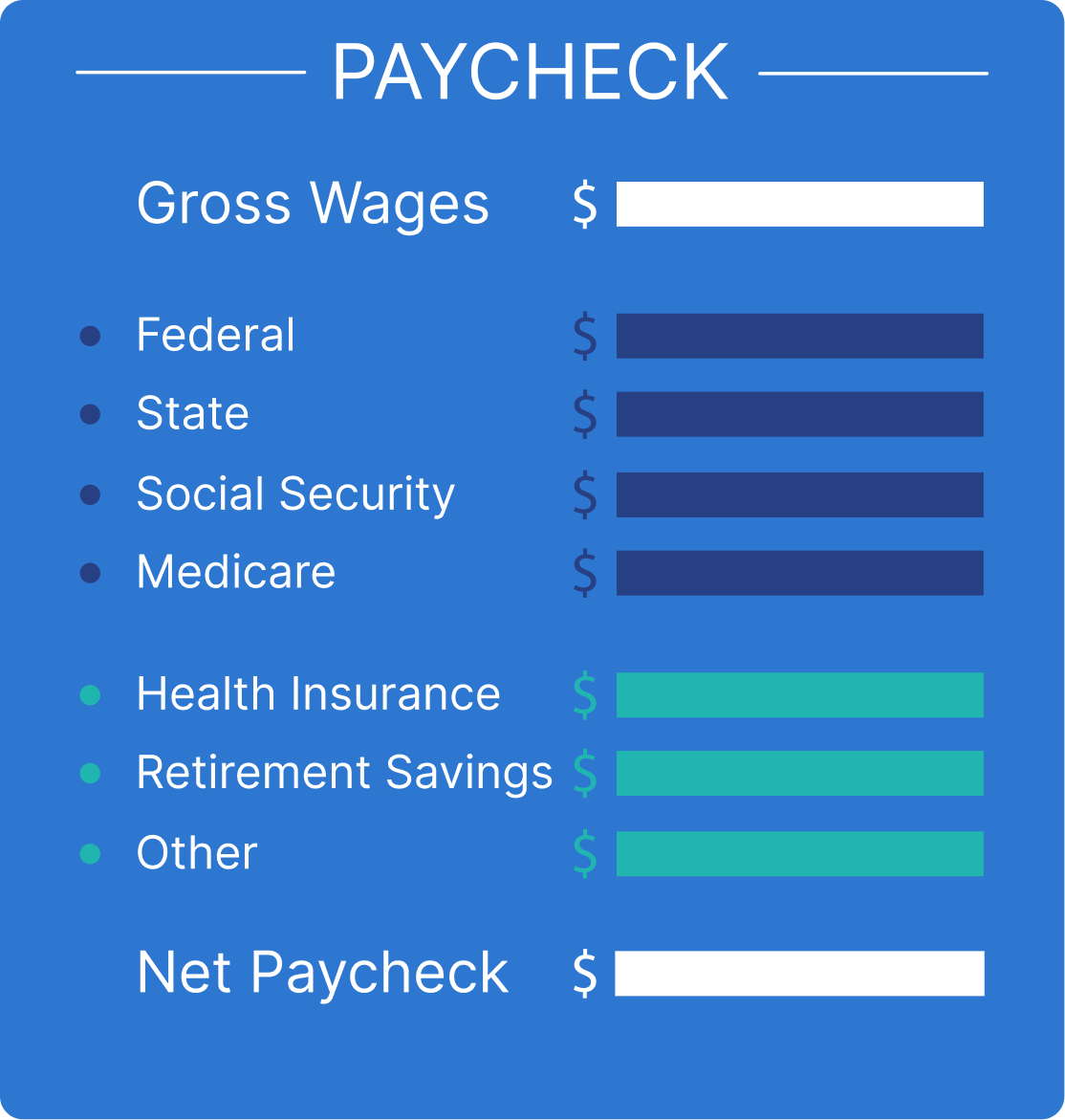
Your take-home pay is not the same as your salary. Why? Because your salary is what you earn before money starts getting taken out to pay for things like taxes and benefits. These deductions cover federal and state taxes, Social Security, Medicare, and benefits such as health insurance and retirement savings.
What are federal taxes for anyway?
Federal taxes are how the government raises the money it needs to pay the nation’s bills. The bottom line is that the more you earn, the higher the percentage of your salary you pay—a structure that’s known as a graduated tax rate.
OK, well what about the state taxes I’m paying?
Each state has its own income tax system. Some states use a graduated tax rate while others charge a flat rate, meaning everyone pays the same percentage regardless of their salary. There are even states that have no income tax at all.
What are the Social Security and Medicare taxes that come out of my paycheck?
Let’s start with Social Security, which is a mandatory government program that provides retirement and disability benefits. To pay for it, the government currently collects 12.4 percent of your salary, up to a limit. So, say someone makes $50,000 per year—their Social Security tax is approximately $6,200.
What do you mean by “up to a limit?”
The Social Security tax applies to the first $184,500 of a person’s salary. Anything that’s earned beyond that is not subject to the tax. This limit changes each year.
OK, now what about Medicare?
Medicare is a mandatory government program that provides hospital insurance. To pay for it, the government currently collects 2.9 percent of your salary. Unlike Social Security, there is no cap on the amount of income that is subject to the Medicare tax. So that person who makes $50,000 has a Medicare tax of approximately $1,500.
It doesn’t seem like I’m paying 12.4 percent of my salary to Social Security or 2.9 percent to Medicare.
You’re right. The good news is that you and your employer split the bill. So for the 12.4 percent Social Security tax, each of you is responsible for paying 6.2 percent. And for the 2.9 percent Medicare tax, each of you pays 1.45 percent.